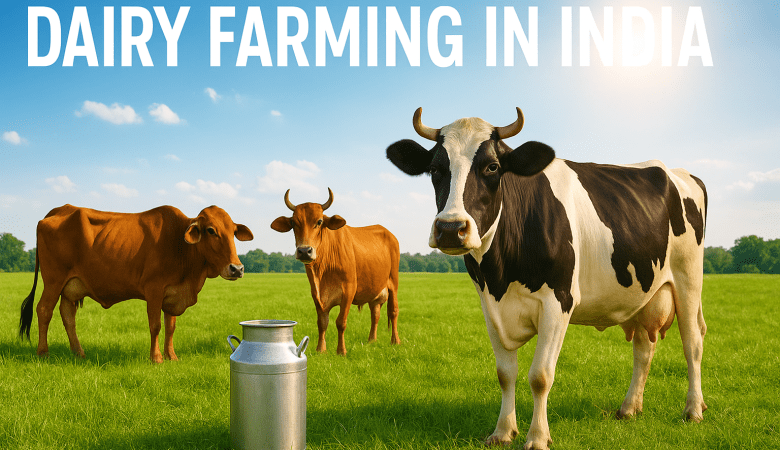
Dairy Farming in India – Importance, Breeds, Performance
Introduction to Dairy Farming in India Dairy farming is one of the oldest and most important agricultural activities in the world. It mainly involves keeping cows, buffaloes, or other milk-producing animals to supply milk for daily use. Milk is considered a complete food because it contains protein, calcium, vitamins, and minerals that are essential for human growth and health. Beyond providing nutrition, dairy farming also plays a vital role in rural economies. For many families, it is a reliable source of income and employment. Farmers not only earn money from selling milk, but also from products like butter, cheese, yogurt, and ghee. Even the by-products, such as cow dung and urine, are useful as organic fertilizers and biogas, making dairy farming an eco-friendly practice. Today, dairy farming is growing rapidly with the help of modern methods and technology. From improved animal breeds and balanced feeding systems to hygienic milking machines and cold storage, farmers are now able to produce high-quality milk more efficiently. This combination of traditional knowledge and modern practices makes dairy farming a sustainable and valuable part of agriculture. Dairy Farming in India Importance of dairy farming Milk is considered one of the most complete foods of animal origin. It contains all the essential nutrients—proteins, fats, carbohydrates, vitamins, and minerals—in the right proportions, making it easy to digest and highly beneficial for human health. Regular consumption of milk not only improves nutrition but also enhances the digestibility of other foods. Milk production varies across the world—some countries produce more than they need, while others face shortages. In India, annual milk production in 2015–16 stood at 155.5 million tonnes, with a per capita availability of 337 grams per day. A vast network of small, medium, and large dairy farms contributes to this figure, with commercial dairy farms expanding rapidly in urban and semi-urban areas. India’s milk comes from diverse sources: buffaloes contribute about 49%, crossbred and exotic cows 27%, indigenous cows 21%, and goats about 3%. Smaller amounts are also obtained from camels, sheep, and yaks. Uttar Pradesh leads in total milk production, followed by Rajasthan, while Punjab and Haryana record the highest per capita availability—1,075 grams and 930 grams respectively in 2016–17. By contrast, Delhi recorded just 35 grams. Demand for milk continues to rise across cities, towns, and rural areas. This is driven by population growth, better education, higher nutritional awareness, and improved purchasing power. In India, around 60% of milk is consumed in liquid form, while the rest is used to prepare ghee, curd, paneer, cheese, ice cream, dairy whiteners, and traditional sweets. Many consumers still prefer raw milk, which is perceived as fresh and natural. Dairy farming plays a vital role in the rural economy. For millions of families, it provides a daily source of income with relatively low risk. Nearly 43% of Indian farmers are small cultivators and 26% are agricultural labourers, many of whom maintain one or two milch animals. For these households, especially in drought-prone areas of Rajasthan and Gujarat, dairy farming provides sustenance and financial security. However, most small farmers still follow traditional methods, which limits productivity. Without adopting scientific practices and proper management, some face losses instead of profits. By improving awareness, training, and access to modern dairy technologies, farmers can enhance milk yields, reduce risks, and secure better livelihoods. In short, dairy farming in India is not only a major source of food and nutrition but also a backbone of rural life, providing employment, income, and stability to millions of families across the country. Employment Potential in Dairying India’s share in the global milk trade is still quite low, and only a small portion of the milk produced in the country is processed. In fact, nearly 65–70% of total milk is handled by the informal sector, where local vendors collect milk directly from farmers and sell it in urban and semi-urban markets. With the rising human population, the demand for food continues to grow. At the same time, cultivable land is shrinking worldwide, making the livestock sector even more important. Dairying not only ensures nutritional security but also provides significant employment opportunities for millions of people. The Agricultural and Processed Food Products Export Development Authority (APEDA) regulates the import and export of dairy products in India. Traditional Indian milk-based sweets, such as rasgulla, are highly popular both in the country and abroad, especially among the Indian diaspora. The demand for such products is expected to grow, opening new avenues for exports. Since India has one of the lowest costs of milk production in the world, it is well-positioned to benefit from the global dairy boom. Both nationally and internationally, the dairy sector offers vast potential for employment, entrepreneurship, and economic growth. Important breeds of cattle A breed is a large group of animals developed over centuries through selective breeding by humans to improve desirable qualities. Animal breeding refers to the scientific practice of rearing domestic animals to enhance traits such as milk production, strength, or adaptability. The main methods used are selective breeding (choosing the best animals within a breed) and crossbreeding (mating animals of different breeds). Animals of the same breed share a common ancestry and have similar physical, physiological, and economic traits that pass from one generation to the next. In India, both indigenous (desi) and crossbred cattle contribute to milk production. Crossbreeds are created by combining Indian breeds (Bos indicus) with exotic breeds (Bos taurus). Exotic cattle generally have higher milk yields, but they are less suited to India’s hot and humid climate compared to indigenous breeds. India’s cattle population is very large, but only about 22–25% is classified as recognized breeds, while the rest are non-descript. A unique feature of indigenous cattle is the hump on their back. Based on utility, Indian cattle are divided into three groups: milch breeds (for milk), dual-purpose breeds (for both milk and draught), and draught breeds (for labor work). India has 41 well-recognized native cattle breeds. Some of the most famous milch breeds are Gir, Sahiwal, Red Sindhi,